

By Charles Batchelor
Lewisham and London paid a heavy toll during the blitz in both lives and property. Memories of a prominent but now almost completely forgotten Lee church lost to bombing in World War II were awakened by the Society’s re-instatement of a parish boundary stone.
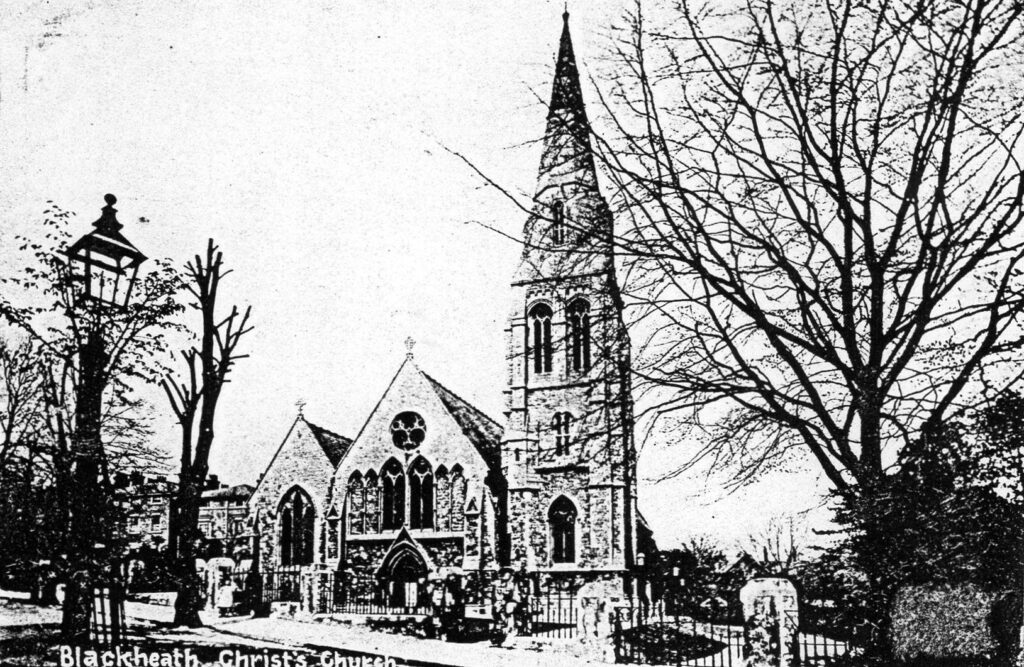
We installed in front of 9 Handen Road a replacement stone marking the boundaries between the Victorian parishes of St Margaret’s (on Lee Terrace) and Christ Church which stood on a large plot of land between Lee Road and Lee Park. The stone, one of a set of seven that still stand in Effingham, Handen, Micheldever and Southbrook Roads is incised with the inscription ‘St M L’ on its western side and ‘CC L’ on the eastern face. (The L denotes the parish of Lee) Apart from the boundary stones, a low stone wall and a set of gate pillars half way up Lee Park are all that remain of a church designed for more than 1,000 worshippers.
As Victorian London spread into what was then Kent and large villas were built on what had previously been orchards and farmland, the mother church of St Margaret’s proved inadequate for the needs of worshippers.
The Parish decided to build “immediately, if the necessary funds can be obtained, a new church.” The material would be Kentish ragstone then available for 9s 6d (47-1/2p) a ton.”The church must be plain and simple, not aiming at any embellishment that may increase expense. But at the same time it should possess a distinct character both ecclesiastically and from an architectural point of view.” A total of £7,863 was raised and the first cornerstone was laid on September 3, 1853 by the rector, the Revd George Lock. The church opened for public worship exactly one year later. Despite the ambitious scale of the new church it soon proved too small and ten years later its west end was extended, adding a further 210 seats. Work on the tower and spire took a further decade to complete.
The church and its congregation flourished until a German bombing raid on September 15, 1940 and a follow-up raid on October 2 destroyed much of the structure. The following May the parochial church council decided to allow the demolition of what remained and in July agreed to the church being rebuilt at a cost of £46,238. But disaster continued to dog the church. The Kilburn works of the company commissioned to restore the damaged organ were themselves bombed and the organ remains reduced to scrap. Lengthy discussions with the Board of Trade over compensation for the damaged church followed but plans for rebuilding were dropped and the site and surrounding area were redeveloped as housing in the 1970s.
Christ Church may have been unlucky to be hit twice by German bombs but it was not the only Lee church to be destroyed in the war. Holy Trinity and St Peters were also lost. The Church of the Good Shepherd in Handen Road was another casualty and the present building is a 1957 replacement for the Victorian original. Christ Church may have gone but we are pleased to have restored a small reminder of an imposing example from the golden age of Victorian church building.
With thanks to Lewisham Local History and Archives Centre, Blackheath Society, David Plumer and “History of Lee” F.H.Hart 1882